

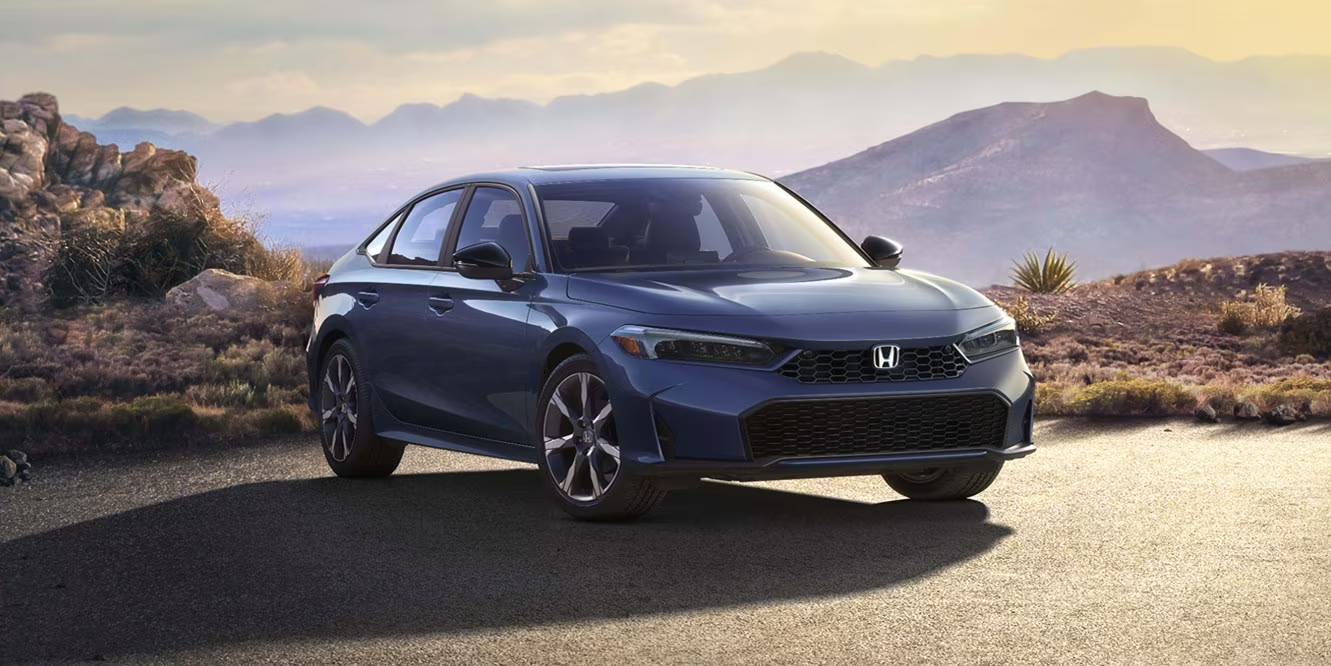
2026 Civic Sedan: MPG Compared
All four sedan trims ranked by EPA-estimated combined MPG. Green rows are the most efficient. Red rows are the least efficient in the sedan lineup. Figures confirmed from the Honda OEM specs page and EPA ratings.
| Trim | Starting MSRP | Engine | City / Hwy / Combined MPG | Rank |
|---|---|---|---|---|
| Sport Hybrid Sedan | Hybrid | $31,895 + $1,195 dest. | 2.0L Atkinson 4-cyl + 2 electric motors | 200 hp combined | CVT | 49 50 city / 47 hwy / 49 combined | Best MPG |
| Sport Touring Hybrid Sedan | Hybrid | Top Trim | $35,495 + $1,195 dest. | 2.0L Atkinson 4-cyl + 2 electric motors | 200 hp combined | CVT | 49 50 city / 47 hwy / 49 combined | Best MPG |
| LX Sedan | Gas | Base Trim | $24,695 + $1,195 dest. | 2.0L 4-cyl naturally aspirated | 150 hp | CVT | 36 32 city / 41 hwy / 36 combined | Best Gas MPG |
| Sport Sedan | Gas | $27,195 + $1,195 dest. | 2.0L 4-cyl naturally aspirated | 150 hp | CVT | 34 31 city / 39 hwy / 34 combined | Lowest MPG |
* EPA estimated MPG. LX and Sport use a 2.0L naturally aspirated engine -- not a turbo. Hybrid trims use a 2.0L Atkinson-cycle engine plus two electric motors for 200 hp combined. Destination charge of $1,195 not included in MSRP. Prices subject to change. Contact Jenkins & Wynne Honda at 931-630-0055 for current inventory and pricing.
What These Numbers Actually Mean
The hybrid trims are in a different category
The 2026 Civic Sport Hybrid and Sport Touring Hybrid both achieve 50 city / 47 highway / 49 combined MPG -- not because they sacrifice power, but because Honda's two-motor hybrid system actually produces more power than the gas trims (200 hp combined versus 150 hp). The electric motor handles most low-speed acceleration, where a gas engine burns the most fuel per mile. That is why the city number (50 MPG) is so high: stop-and-go driving is where hybrids have the largest advantage over conventional gas engines.
Both hybrid trims use the same powertrain, so their MPG ratings are identical. The choice between them comes down to features: the Sport Touring Hybrid adds leather seating, a 12-speaker Bose audio system, a 10.2-inch digital instrument cluster, and wireless charging, while the Sport Hybrid covers heated seats, a moonroof, and a 9-inch touchscreen. If MPG is the only goal, both deliver the same number.
Why the Sport gets slightly worse MPG than the LX
The LX and Sport use the exact same 2.0-liter naturally aspirated engine producing 150 horsepower -- not a different engine. The Sport's lower fuel economy (34 MPG combined versus 36 MPG for the LX) comes from its larger 17-inch wheels, which create slightly more rolling resistance than the LX's 16-inch wheels. The difference is 2 MPG combined and roughly $100-$130 per year in fuel cost at typical driving distances. Whether that matters to you depends on whether you are optimizing for the best possible gas trim MPG (LX) or want the Sport's styling additions and upgraded 9-inch touchscreen.
The hybrid payback calculation for Clarksville commuters
The Sport Hybrid starts at $31,895 -- $7,200 more than the LX at $24,695. At 15,000 miles per year and $3.50 per gallon, the LX costs approximately $1,458 in fuel annually (at 36 MPG combined). The Sport Hybrid costs approximately $1,071 annually (at 49 MPG combined). That is a saving of roughly $387 per year, meaning the fuel savings alone take about 18-19 years to cover the price gap.
That math makes the hybrid harder to justify on fuel savings alone -- but that is not how most buyers actually make the decision. The Sport Hybrid also brings 50 more horsepower, heated front seats, a moonroof, and a 9-inch touchscreen compared to the base LX. For buyers who want those features and also want strong MPG, the Sport Hybrid is a good fit. For buyers whose only goal is the lowest possible fuel cost per mile, the LX at $24,695 is the more straightforward choice.
Tank size and range
The gas trims (LX and Sport) use a 12.4-gallon fuel tank. At the LX's 36 MPG combined, that is roughly 446 miles of combined-driving range per tank. The hybrid trims use a slightly smaller 10.6-gallon tank to accommodate the battery pack. At 49 MPG combined, the Sport Hybrid achieves approximately 519 miles of range per tank -- about 73 miles more per fill-up than the LX, despite a smaller tank. For Clarksville residents making regular runs up I-24 toward Nashville, or Fort Campbell families doing longer road trips, that range difference is meaningful.
What Honda Sensing has to do with efficiency
All four Civic sedan trims include Honda Sensing standard, which covers adaptive cruise control with low-speed follow. On highway stretches -- like the I-24 corridor between Clarksville and Nashville -- adaptive cruise tends to smooth out throttle inputs compared to manual driving, which can improve real-world highway MPG by a few points over the EPA estimate. This applies to gas and hybrid trims equally. It is a small but real advantage over older Civics that did not include the system standard.